
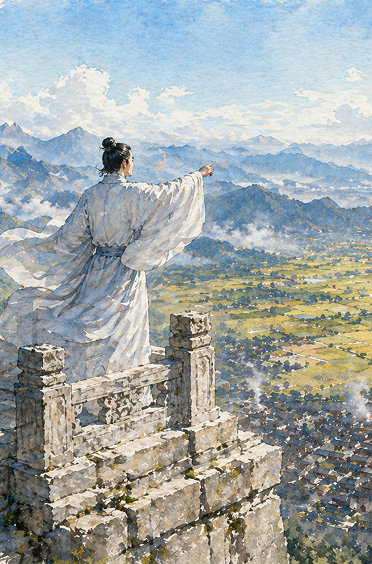
Hexagram Study
Hexagram 20 (Contemplation [View]) in Study: I Ching Guidance for Learning and Growth
What does Hexagram 20 (Contemplation [View]) teach about study and learning? The sacrificial ritual in China began with an ablution and a libation by which the Deity was invoked, after which the sacrifice was offered. The moment of time... See how the I Ching guides intellectual growth, skill development, and the discipline of deepening knowledge.
Introduction
You've been reading the same paragraph for fifteen minutes, and the words refuse to land. Your highlighter hovers over sentences you've already marked three times. The material feels distant, abstract—something you're supposed to absorb but can't quite touch. You wonder if you're doing it wrong, if other learners somehow possess a secret you've missed. This moment of stalled progress, of staring at knowledge without truly seeing it, is precisely where Hexagram 20 (Contemplation [View]) begins its work.
The ancient Chinese text describes a ritual moment between two sacred acts—the washing of hands and the offering of sacrifice—when the participants stand in complete stillness, their attention gathered into a single point of presence. This is the essence of Contemplation [View]: not passive looking, but active, reverent attention that transforms both the observer and what is observed. The hexagram's structure—Wind above, Earth below—pictures the invisible force of understanding moving across the solid ground of experience, bending what is rigid and carrying what is light. For the learner, this hexagram speaks to the quality of attention you bring to your studies, and how that attention shapes everything that follows.
If you've been struggling to move past surface-level comprehension, if you sense there's more to your subject than you're currently grasping, or if you feel the pressure to produce results before you've truly understood—then Hexagram 20 offers a different path. It asks you to slow down, to look again, and to trust that the deepest learning happens not in the frantic gathering of facts but in the quiet space between knowing and not-yet-knowing.
Where This Guide Is Most Useful
- When you feel stuck in passive learning—reading, watching, or listening without genuine comprehension. Contemplation [View] addresses the gap between exposure and understanding, helping you transform mere consumption into active insight.
- When you need to assess your learning approach honestly—you suspect your study methods aren't serving you, but you can't see clearly what needs to change. This hexagram provides a framework for self-examination without self-judgment.
- When you're preparing to teach or share knowledge—whether as a tutor, mentor, or colleague. The hexagram's emphasis on influence through presence speaks directly to how your own depth of understanding affects others.
Understanding Contemplation [View] in Learning & Study Context
The Judgment of Hexagram 20 describes a moment of "deepest inner concentration" that occurs between two visible actions. For the learner, this maps directly onto the experience of genuine study. You pick up a book (the ablution), you set it down (the libation), but the learning itself happens in the charged space between—when your mind is fully present, neither reaching ahead nor falling back, simply attending to what is before you. This quality of attention is not passive receptivity but active, reverent engagement.
The trigrams deepen this insight. Wind (Xun) above Earth (Kun) pictures invisible force moving over receptive ground. Wind cannot be seen, only felt through its effects—the bending grass, the carried leaves. Similarly, genuine understanding cannot be directly observed, only known through its results: the ability to explain, to apply, to connect. The Earth trigram beneath represents your current foundation of knowledge, the solid ground from which learning grows. When Wind moves over Earth, it shapes and transforms without violence. When genuine contemplation moves over your existing knowledge, it reorganizes and deepens without force.
The Image commentary draws a parallel between the ruler who surveys his realm and the sage who influences through presence. For the student, this means two things. First, you must survey your own mental landscape—what do you actually know? Where are the gaps? What assumptions are you carrying? Second, you must recognize that your depth of understanding exerts an influence on others, whether you intend it or not. The student who has truly contemplated a subject speaks differently, asks different questions, and inspires different responses than one who has merely collected information.
Genuine learning is not the accumulation of facts but the transformation of attention. Contemplation [View] teaches that how you look determines what you see.
How Contemplation [View] Shows Up in Real Learning & Study Situations
Consider the experience of preparing for an important exam or presentation. You've studied for weeks, yet when someone asks a question slightly outside your prepared material, you freeze. This is the difference between studying with Contemplation [View] and studying without it. The learner who merely memorizes has looked at the material through a crack in the door—Line 2's limited outlook—seeing only what relates directly to their immediate goal. The learner who contemplates has stood back, surveyed the whole territory, and understood how each piece connects to the larger structure.
Another recognizable pattern: the student who cannot stop researching. They collect articles, highlight passages, fill notebooks, yet never feel ready to act. This is contemplation without completion—the Wind blowing endlessly without settling into the Earth. Hexagram 20 does not advocate for endless observation. The ritual has a beginning and an end; the sacred moment between is bounded. True contemplation leads to action, to the libation, to the offering made. If your study never produces a result—a paper written, a concept taught, a problem solved—you may be mistaking preparation for learning itself.
The most subtle manifestation of Contemplation [View] appears in how you carry yourself when you have truly understood something. The Judgment speaks of a "hidden spiritual power" that emanates from those who have deeply contemplated the laws of life. In learning contexts, this translates to quiet confidence. You don't need to prove you know the material; your questions, your explanations, your ability to listen and respond appropriately all communicate your depth without effort. Other learners sense this and are drawn to it—not because you're performing expertise, but because your understanding has become part of you.
The learner who has truly contemplated no longer needs to prove their knowledge. Their presence teaches before they speak a word.
From Reading to Action: Applying Contemplation [View]
To apply Hexagram 20 to your studies, begin with the Image: "When the wind blows over the earth it goes far and wide, and the grass must bend to its power." This is not a command to dominate your subject through force of will. Rather, it describes the natural effect of sustained, gentle attention. Your task is to become the Wind—present, persistent, and patient. Set aside the impulse to conquer difficult material in a single session. Instead, return to it regularly, allowing each exposure to deepen your understanding incrementally.
Line 3 offers a crucial pivot point. The text says this is "the place of transition," where you stop looking outward for answers and begin "self-contemplation." In practical terms, this means shifting from consuming information to examining your own understanding. After reading a chapter, close the book and ask: What do I actually grasp? Where am I confused? What would I need to explain this to someone else? This self-examination is not self-criticism; it is honest assessment that guides your next steps. Line 3 warns against "preoccupation with one's own thoughts" and instead emphasizes "concern about the effects one creates." Your learning must produce something—a clearer explanation, a better argument, a more skillful practice.
Lines 5 and 6 address the culmination of contemplation. Line 5 describes a person in authority who examines "the effects one produces." For the advanced learner, this means testing your understanding against real-world outcomes. Can you apply what you've learned? Does your knowledge hold up under scrutiny? Line 6 goes further, describing a sage who stands "outside the affairs of the world," liberated from ego. This is the rare state of learning for its own sake, without concern for grades, credentials, or recognition. While few of us achieve this consistently, it serves as an ideal: the purest learning happens when you forget yourself entirely and attend only to what is true.
Apply Contemplation [View] by shifting from passive consumption to active self-examination, then to real-world application. Each stage deepens the other.
Practical Examples
Example 1: The Graduate Student Facing Comprehensive Exams
Situation: Maria has been studying for her doctoral comprehensive exams for three months. She has read hundreds of articles, filled three notebooks, and can recite key authors and dates. Yet when her advisor asks her to explain the central debate in her field, she fumbles. She knows the pieces but cannot see the whole.
How to read it: Maria has been studying from Line 2's position—"through the crack of the door." She has focused on individual facts without stepping back to see the full landscape. The material has not yet become Wind moving over Earth; it remains scattered data without organizing principles.
Next step: Maria should spend one week doing nothing but creating conceptual maps. No new reading. No note-taking. She should draw connections between authors, identify the core questions that drive her field, and practice explaining the big picture to someone unfamiliar with the subject. This is Line 3's self-contemplation: examining what she actually understands versus what she has merely collected.
Example 2: The Professional Learning a New Skill
Situation: James is a project manager learning data analysis to improve his team's reporting. He has completed two online courses and can follow tutorials step by step, but when faced with a real dataset, he doesn't know where to start. He feels like an impostor.
How to read it: James has learned techniques but not principles. He has looked at the material without truly contemplating it—the difference between following a recipe and understanding cooking. His study has been transactional (finish the course, get the certificate) rather than transformational (absorb the logic, internalize the approach).
Next step: James should pick one real dataset from his work and commit to analyzing it completely, even if it takes weeks. He should document his process, note where he gets stuck, and seek help only for specific obstacles. This is Line 4's position—becoming a "guest" who is honored for his expertise, which means he must first earn that expertise through genuine understanding. The struggle with real data will reveal what he actually knows.
Example 3: The Tutor Struggling to Connect with Students
Situation: Priya tutors high school students in mathematics. She knows the material perfectly and can solve any problem, but her students don't improve. They say she explains too quickly, that she assumes too much, that she doesn't understand their confusion.
How to read it: Priya has mastered her subject but not the art of teaching it. She has contemplated the material (Line 5's self-examination of effects) but only from her own perspective. She needs to shift to Line 6's position—liberated from ego—and contemplate her students' experience rather than her own knowledge.
Next step: Priya should ask each student to "teach back" a concept after her explanation, watching carefully for where their understanding breaks down. She should record her own explanations and listen for assumptions she makes. Most importantly, she should study her students as carefully as she studied mathematics—learning their patterns, their sticking points, their ways of thinking. This is Contemplation [View] applied to teaching: seeing clearly enough to influence without forcing.
Each example shows the same principle: genuine learning requires stepping back from the details to see the whole, then returning with clearer vision.
Common Mistakes
- Mistaking passive reading for contemplation. You can stare at a page for hours without truly seeing. Contemplation [View] requires active engagement—questioning, connecting, testing. If you finish a chapter and cannot summarize its argument, you have not contemplated; you have merely looked.
- Believing that more information equals deeper understanding. Line 1 warns of "contemplation from a distance, without comprehension." Collecting sources, downloading papers, and building bibliographies can create the illusion of progress while leaving your actual understanding shallow. Contemplation [View] prioritizes depth over breadth.
- Using self-examination as an excuse for inaction. Line 3's call to examine yourself can become a trap. Some learners perpetually analyze their study habits, their comprehension, their progress—but never actually produce anything. The purpose of self-contemplation is to guide action, not to replace it.
- Expecting contemplation to be effortless. The Judgment describes "deepest inner concentration" as the most sacred moment, implying effort and discipline. Contemplation [View] is not a passive state you fall into; it is a practice you cultivate. It demands your full presence, which is why it feels so difficult in an age of distraction.
Closing Reflection
Contemplation [View] challenges the modern assumption that more is better—more speed, more information, more productivity. It asks you to trust the still point, the moment of gathered attention between action and action. In your studies, this means valuing depth over breadth, understanding over coverage, presence over efficiency. The learner who contemplates does not merely know more; they see differently. And this changed vision, cultivated through patient attention, becomes the foundation for everything else. You cannot force understanding, but you can prepare the ground for it by learning to look with reverence, with patience, and with the quiet confidence that the Wind always finds its way across the Earth.
Frequently Asked Questions
Sources & References
Zhouyi / I Ching primary text
The received text of the Book of Changes, including the Judgment, Image, and line statements.
The I Ching or Book of Changes, Richard Wilhelm / Cary F. Baynes
Princeton University Press translation used as a major English-language reference point for names, structure, and commentary framing.
The Sacred Books of China: The Texts of Confucianism, James Legge
Classical English reference used for comparative reading of source terminology and commentarial tradition.
The Classic of Changes, Richard John Lynn
Modern scholarly translation consulted for comparative interpretation and editorial cross-checking.
Related Hexagrams
Continue from this guide into specific hexagram study.
Related Guides
Continue with adjacent guides for more context and deeper study.