
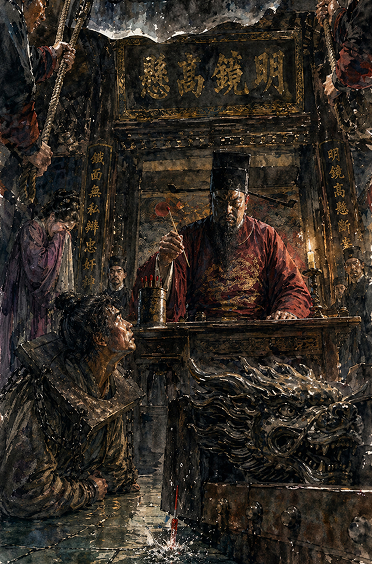
Hexagram Career
Hexagram 43 (Break-through [Resoluteness]) in Career: I Ching Guidance for Work and Professional Life
What does Hexagram 43 (Break-through [Resoluteness]) mean for your career? Even if only one inferior man is occupying a ruling position in a city, he is able to oppress superior men. Even a single passion still lurking in the heart has... Learn how the I Ching guides professional decisions, leadership, timing, and workplace dynamics.
Introduction
You've been watching a situation at work deteriorate for months. Perhaps it's a colleague whose chronic negativity poisons every team meeting. Maybe it's a project that has drifted so far from its original purpose that continuing feels like a betrayal of your professional standards. Or it could be an internal habit—the way you avoid difficult conversations, or the perfectionism that keeps you from shipping work on time. You know something has to change. But every time you try to address it directly, you find yourself entangled in blame, defensiveness, or your own hesitation. The harder you push, the more resistance you meet.
This is the terrain of Hexagram 43, called Break-through [Resoluteness]. In the classical sequence, this hexagram follows Hexagram 42 (Increase), suggesting that growth eventually demands a decisive clearing—a moment when what has been tolerated can no longer be accommodated. The Judgment makes this stark: "Passion and reason cannot exist side by side—therefore fight without quarter is necessary if the good is to prevail." But before you imagine this as a call to confrontational warfare, notice the structure. The trigrams are Lake (Dui) above and Heaven (Qian) below. Lake represents joy and open expression; Heaven represents creative strength and constancy. The breakthrough is not about aggression but about bringing suppressed truth to the surface with both strength and grace.
If you are in a career situation where something inferior—a person, a pattern, a compromise—has been allowed to persist, and you feel the growing tension between what is and what should be, Hexagram 43 offers a surprisingly subtle guide. It does not tell you to charge in blindly. It tells you how to win without becoming what you oppose.
Where This Guide Is Most Useful
-
When you must address a toxic workplace dynamic—a colleague whose behavior undermines the team, a manager who tolerates mediocrity, or a cultural norm that conflicts with your values. You sense that silence has become complicity, but you're unsure how to speak without making things worse.
-
When an internal obstacle blocks your professional growth—a habit of procrastination, a fear of visibility, or a recurring pattern of self-sabotage. You've tried gentle approaches, but the pattern persists. You need a more resolute strategy for change.
-
When a project or initiative has become corrupted—scope creep has diluted the original vision, political compromises have weakened the outcome, or inertia has replaced purpose. You need to decide whether to fight for correction or walk away cleanly.
Understanding Break-through [Resoluteness] in Career & Work Context
The name Break-through [Resoluteness] can be misleading. In English, "breakthrough" often suggests a sudden, dramatic success—the big promotion, the game-changing idea, the decisive victory. But the Chinese character guai carries a different weight. It means to part, to divide, to make a decisive decision. The Wilhelm/Baynes translation captures this with the dual name: the breakthrough is the outer event, but resoluteness is the inner quality required to achieve it. In career terms, this hexagram is less about winning a single battle and more about cultivating the clarity to know what must end and the courage to end it.
The trigram structure reveals the method. Heaven below represents your foundation—your principles, your competence, your steady work. Lake above represents the surface where things become visible and expressible. In career terms, this means that genuine breakthrough begins with internal clarity (Heaven) before it can be expressed externally (Lake). The Image drives this home with a striking metaphor: "When the water of a lake has risen up to heaven, there is reason to fear a cloudburst." A lake cannot keep rising indefinitely. At some point, the water must release. The same is true in your professional life. You cannot accumulate frustration, compromise, or suppressed truth forever. The release will come—either as a controlled clearing or as a destructive flood.
The Judgment offers a sophisticated framework for this clearing. It acknowledges that "even a single passion still lurking in the heart has power to obscure reason." This is not merely about external enemies. It is about the internal contradictions that compromise your professional judgment. The hexagram asks you to examine what you have been tolerating—in others and in yourself—and to recognize that tolerance has become a form of participation. The breakthrough is not about punishing the inferior; it is about restoring integrity to the whole.
The breakthrough begins not with confronting others, but with recognizing what you have allowed to persist in yourself.
How Break-through [Resoluteness] Shows Up in Real Career & Work Situations
Consider a typical scenario: you work on a team where one member consistently misses deadlines, delivers substandard work, and deflects responsibility. The rest of the team compensates, resenting the imbalance but avoiding direct confrontation. Everyone knows the situation is unsustainable. Yet when someone finally raises the issue, the conversation goes badly. The underperformer becomes defensive. The manager mediates weakly. The team splits into factions. What was meant to be a breakthrough becomes a breakdown.
Hexagram 43 diagnoses exactly this dynamic. The Judgment warns that "a compromise with evil is not possible; evil must under all circumstances be openly discredited." But it immediately adds that "the struggle must not be carried on directly by force." This is the paradox at the heart of the hexagram. You must name what is wrong, but you must do so in a way that does not create a fight. How? The answer lies in the image of the lake rising to heaven. The water does not attack the sky. It simply rises until the release is inevitable. In career terms, this means building such clarity, such consensus, such factual grounding, that the need for change becomes self-evident. You do not need to defeat the inferior person or pattern. You need to make its inferiority visible to everyone, including the person themselves.
Another common scenario involves internal obstacles. A talented professional struggles with impostor syndrome. They know their work is good, but they cannot internalize that knowledge. Every presentation causes anxiety. Every performance review triggers self-doubt. They have tried positive affirmations and therapy, but the pattern returns. Hexagram 43 suggests a different approach. The Judgment states: "We should not combat our own faults directly. As long as we wrestle with them, they continue victorious. The best way to fight evil is to make energetic progress in the good." Instead of fighting the impostor syndrome directly, pour your energy into producing work so undeniable that the syndrome has nothing to attach to. The breakthrough happens not through self-critique but through self-expression.
The most effective way to clear an obstacle is often to build something so substantial that the obstacle becomes irrelevant.
From Reading to Action: Applying Break-through [Resoluteness]
The six lines of Hexagram 43 offer a step-by-step guide to navigating a professional breakthrough. Each line describes a specific position and the conduct appropriate to it. Taken together, they form a complete strategy.
Line 1 says: "In times of a resolute advance, the beginning is especially difficult." The line counsels caution. You feel the urgency to act, but resistance is still strong. The mistake here is to plunge ahead blindly, which can "have the most disastrous results." In career terms, this means not resigning in a fit of frustration, not sending that angry email, not confronting your boss without preparation. Instead, gauge your strength. Assess the terrain. Build your case before you make your move.
Line 2 offers the counterbalance: "Readiness is everything." The superior man "is on his guard against what is not yet in sight and on the alert for what is not yet within hearing." This is the line of preparation. Before you act, ensure your foundation is solid. Have you documented the pattern? Have you built alliances? Have you clarified your own motives? The line promises that if you are truly prepared, "people submit to him of their own accord." When your position is grounded in truth and competence, you do not need to force anything.
Line 3 describes the most difficult position. Here you have a relationship with the very person or pattern you need to break from. Perhaps it's a mentor who has become toxic, or a project you helped create that has gone wrong. The line warns that if you "show strength outwardly and turn against this man before the time is ripe, you would only endanger the entire situation." You must remain "firmly resolved within yourself" while maintaining external composure. You will be misunderstood. People will think you are complicit. But you must endure this loneliness, because premature action is worse than temporary misjudgment.
Line 4 warns against inner restlessness. The person in this position "would like to push forward under any circumstances, but encounters insuperable obstacles." The cause is obstinacy—a refusal to adapt when the situation demands patience. If you find yourself frustrated by blocked progress, the line suggests examining whether your will has become rigid. Sometimes the breakthrough requires a change in direction, not a harder push.
Line 5 addresses the leader. "Weeds always grow back again and are difficult to exterminate." Even after a breakthrough, remnants remain. The leader must stay resolute, not allowing discouragement to derail the process. In career terms, this means following through. After the difficult conversation, after the policy change, after the resignation—continue to monitor and reinforce. The breakthrough is not a single event but a sustained commitment.
Line 6 describes the final danger: complacency. "Victory seems to have been achieved. There remains merely a remnant of the evil resolutely to be eradicated." The tendency is to relax, to assume the work is done. But "evil does not die easily." In career terms, this means the old pattern will try to reassert itself. The colleague may find new ways to undermine. The old habit may return in a different form. The final line demands thoroughness.
A true breakthrough is not a single act of courage but a sustained practice of integrity.
Practical Examples
Example 1: The Toxic Team Member
Situation: You lead a team of five. One member, Alex, consistently delivers late, blames others, and creates tension. The team is demoralized. You've had private conversations, but nothing changes. Other team members are considering leaving.
How to read it: This is the classic scenario of Hexagram 43. The "inferior man" is occupying a ruling position—not formally, but through the influence of their negativity. The Judgment warns against fighting directly. Instead, you must build a case so clear that the need for action becomes obvious. Document the missed deadlines. Collect feedback from the team. Prepare a performance improvement plan with specific, measurable expectations. This is the work of Line 2: readiness.
Next step: Schedule a meeting with Alex. Do not attack. Present the facts without emotion. State the standard and the gap. Offer support but make the consequences clear. If Alex improves, you have achieved breakthrough through clarity. If not, you have built the foundation for termination that will be seen as fair by the entire team.
Example 2: The Career Plateau
Situation: You've been in the same role for four years. You're competent, even excellent, but you're not growing. Every time you consider asking for a promotion or new responsibilities, you talk yourself out of it. You tell yourself you're not ready, not qualified, not deserving.
How to read it: This is the internal application of Hexagram 43. The "inferior" is not a person but a pattern of self-doubt. The Judgment says not to fight this pattern directly. Instead, "make energetic progress in the good." Stop focusing on your inadequacy and start producing work that demonstrates your readiness. Take on a visible project. Share your expertise publicly. Build the evidence of your value.
Next step: Identify one project that would clearly demonstrate your readiness for the next level. Commit to completing it within a defined timeframe. Do not ask for permission—ask for forgiveness later. When the project succeeds, use it as the basis for the promotion conversation. The breakthrough is not about defeating your doubt; it's about making your doubt irrelevant.
Example 3: The Corrupted Initiative
Situation: You championed a new initiative six months ago. It was intended to solve a real problem. But through political compromises and scope creep, the initiative has become something you barely recognize. You're now implementing a solution you don't believe in.
How to read it: This mirrors the Image of Hexagram 43: the lake has risen but threatens a destructive cloudburst. The initiative has accumulated so many compromises that it is about to collapse under its own weight. The Image advises: "If a man were to pile up riches for himself alone, without considering others, he would certainly experience a collapse." The breakthrough requires honesty about what has gone wrong.
Next step: Write a clear assessment of the initiative's current state versus its original purpose. Present it to stakeholders with a recommendation: either return to the original vision or formally close the initiative. This is the work of Line 5—the leader's resolute clarity. You may face resistance, but the alternative is a slow, painful failure that damages your credibility more than a clean break would.
Common Mistakes
-
Mistaking aggression for resoluteness. The Judgment explicitly warns against fighting "blow for blow." Resoluteness is not about volume or force. It is about clarity and persistence. Many professionals mistake harshness for strength and damage their relationships in the process.
-
Waiting for the perfect moment. Line 1 counsels caution, but Line 2 warns that readiness is everything. Some people use "waiting for the right time" as an excuse for inaction. The breakthrough requires timing, not paralysis. The difference between caution and avoidance is whether you are actively preparing.
-
Focusing only on external obstacles. Hexagram 43 is as much about internal clearing as external confrontation. Professionals often blame their environment while ignoring their own patterns of avoidance, people-pleasing, or perfectionism. The breakthrough must include self-examination.
-
Assuming the breakthrough is permanent. Line 6 warns that remnants remain. Many people succeed in a difficult conversation or a career change, then relax too soon. The old pattern will try to reassert itself. Sustained vigilance is required.
Closing Reflection
Hexagram 43 reminds us that the most important career breakthroughs are not about winning external battles but about restoring internal integrity. The water of the lake must rise to heaven—not to flood the world, but to complete a natural cycle. Similarly, the tensions you feel at work are not signs of failure. They are signs that something has accumulated and now seeks release. Your task is not to force that release but to guide it with clarity, patience, and courage. The breakthrough you seek is not something you create. It is something you prepare for, and then allow to happen. When you act from this grounded resoluteness, you do not need to fight the inferior; you simply become too substantial for it to coexist with you.
Frequently Asked Questions
Sources & References
Zhouyi / I Ching primary text
The received text of the Book of Changes, including the Judgment, Image, and line statements.
The I Ching or Book of Changes, Richard Wilhelm / Cary F. Baynes
Princeton University Press translation used as a major English-language reference point for names, structure, and commentary framing.
The Sacred Books of China: The Texts of Confucianism, James Legge
Classical English reference used for comparative reading of source terminology and commentarial tradition.
The Classic of Changes, Richard John Lynn
Modern scholarly translation consulted for comparative interpretation and editorial cross-checking.
Related Hexagrams
Continue from this guide into specific hexagram study.
Related Guides
Continue with adjacent guides for more context and deeper study.