
Hexagram Health
Hexagram 52 (Keeping Still [Mountain]) in Health: I Ching Guidance for Wellbeing and Vitality
What does Hexagram 52 (Keeping Still [Mountain]) suggest about health and wellbeing? True quiet means keeping still when the time has come to keep still, and going forward when the time has come to go forward. In this way rest and movement are i... Explore how the I Ching frames the balance of energy, rest, and renewal.
Introduction
You wake up already tired. Your mind is racing through the day's obligations before your feet have touched the floor. You reach for your phone to check messages, scan the news, and confirm appointments—all before you've taken a single conscious breath. Later, you push through a workout you don't enjoy, eat lunch at your desk while answering emails, and collapse into bed still mentally processing the day's unresolved tensions. Your body feels like a vehicle you're driving too fast on a road you didn't choose. Something in you knows this pace is unsustainable, but stopping feels impossible—like falling behind, like wasting time, like admitting weakness.
This is precisely the territory that Hexagram 52 (Keeping Still [Mountain]) addresses. In the I Ching, this hexagram is composed of the trigram Mountain doubled—Mountain above, Mountain below. It represents the power of stillness, not as passivity or avoidance, but as a profound act of alignment with what is actually needed in each moment. The Judgment speaks directly to our health struggles: "True quiet means keeping still when the time has come to keep still, and going forward when the time has come to go forward. In this way rest and movement are in agreement with the demands of the time, and thus there is light in life."
If you've been feeling depleted, scattered, or disconnected from your body's wisdom, this hexagram offers a different way forward. It doesn't ask you to do more or try harder. It asks you to recognize that some of your deepest healing will come not from action, but from the quality of your stillness.
Where This Guide Is Most Useful
- You are experiencing chronic fatigue or burnout and suspect that more rest—not more effort—is what your body truly needs, yet you struggle to grant yourself permission to stop.
- You have a health condition that requires careful pacing, and you need guidance on when to push forward and when to hold back without guilt or anxiety.
- You feel mentally scattered and unable to focus on your wellbeing, as though your thoughts are pulling you in too many directions at once, and you need a framework for settling your mind.
Understanding Keeping Still [Mountain] in Health & Wellbeing Context
The I Ching's Image for Hexagram 52 offers a striking observation: "The heart thinks constantly. This cannot be changed, but the movements of the heart—that is, a man's thoughts—should restrict themselves to the immediate situation. All thinking that goes beyond this only makes the heart sore." In a health context, this is a direct commentary on the toll that mental overactivity takes on our physical bodies. Your nervous system cannot distinguish between a real threat and a worried thought. When your mind races about future health outcomes, past mistakes, or hypothetical scenarios, your body responds as though it is under attack—elevating cortisol, disrupting sleep, and diverting energy from repair and regeneration.
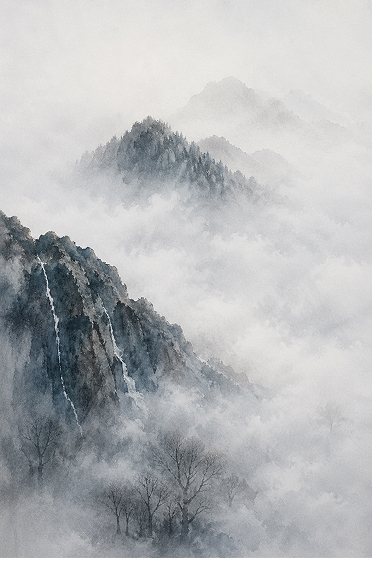
The doubled Mountain trigram reinforces this message. Mountains are massive, immovable, and silent. They do not chase after anything. They simply stand. In your health journey, this hexagram invites you to cultivate the quality of the mountain within your own being—a centered stability that does not react to every internal or external stimulus. This is not about suppressing your feelings or denying your symptoms. It is about creating enough inner space that you can observe what is happening without being consumed by it.
The Judgment's reference to the back is particularly significant for health. The I Ching notes that the back contains the nerve fibers that mediate all movement. When these are brought to stillness, "the ego, with its restlessness, disappears as it were." This is a remarkable insight into the physiology of stress. So much of our physical tension accumulates in the spine and supporting muscles—the very structures that prepare us for action. When you learn to consciously release this tension, you are not just relaxing muscles. You are signaling to your entire nervous system that it is safe to stop preparing for battle.
Takeaway: True health begins not with what you do, but with what you allow yourself to stop doing. Stillness is not emptiness—it is the ground from which all wise action grows.
How Keeping Still [Mountain] Shows Up in Real Health & Wellbeing Situations
Consider the person who has been told they need to reduce stress for the sake of their heart health. They dutifully sign up for a meditation app, attend a yoga class, and schedule a massage. But their approach to stress reduction is itself stressful—they track their meditation streaks, judge their yoga performance, and feel guilty when they miss a session. Their mind has turned relaxation into another project to master. Hexagram 52 recognizes this pattern and offers a different way: stillness cannot be forced. The third line warns explicitly about this: "The restless heart is to be subdued by forcible means. But fire when it is smothered changes into acrid smoke that suffocates as it spreads."
Another common scenario involves the person managing a chronic condition that requires careful energy management. They know they need to rest, but they cannot seem to do it without feeling lazy or unproductive. So they rest with resentment, scrolling through social media while mentally composing their to-do list. This is not true stillness—it is suspended agitation. The hexagram teaches that genuine rest involves a complete turning away from the ego's demands. When you rest, you must actually rest—not just pause your body while your mind continues its frantic activity.
Then there is the situation of recovery from illness or injury. Many people try to rush back to full activity before their bodies are ready. They interpret stillness as weakness and movement as virtue. Hexagram 52 offers a more nuanced view: there is a time for stillness and a time for movement, and wisdom lies in discerning which is needed now. The first line speaks to this: "Keeping the toes still means halting before one has even begun to move. The beginning is the time of few mistakes." In health, this might mean recognizing early warning signs and adjusting course before a full breakdown occurs.
Takeaway: The quality of your rest matters as much as its quantity. Half-hearted stillness—the body at rest while the mind races—provides no true restoration.
From Reading to Action: Applying Keeping Still [Mountain]
To work with Hexagram 52 in your health practice, begin by recognizing that stillness is a skill that must be cultivated, not a state you can demand of yourself. The fourth line offers important guidance: "Keeping the heart at rest is an important function, leading in the end to the complete elimination of egotistic drives." You start not by trying to empty your mind, but by practicing the art of keeping your attention on the present moment—on your breath, on the sensations in your body, on the immediate task before you.
A practical approach involves three steps. First, create physical anchors for stillness. Place your attention on your back—the area the hexagram names explicitly. Lie down and feel the contact between your spine and the surface beneath you. Notice where you are holding tension and consciously release it. This is not a mental exercise; it is a direct communication with your nervous system. The second line reminds us that "the leg cannot move independently; it depends on the movement of the body." Your physical stillness supports your mental stillness, and vice versa. They work together.
Second, practice discerning between necessary and unnecessary movement. The Judgment says that rest and movement should be "in agreement with the demands of the time." Before you act—whether that means exercising, eating, working, or socializing—pause and ask: Does this action serve my wellbeing right now, or is it driven by habit, anxiety, or obligation? The fifth line counsels restraint in speech: "If a man is reserved in speech, his words take ever more definite form." In health, this translates to being reserved in action—letting your choices arise from clarity rather than compulsion.
Third, cultivate the attitude of the sixth line, which marks the consummation of tranquility: "One is at rest, not merely in a small, circumscribed way in regard to matters of detail, but one has also a general resignation in regard to life as a whole." This does not mean giving up on your health. It means releasing the desperate grip of needing to control every outcome. When you can rest in the fundamental trust that your body knows how to heal, you create the conditions for that healing to occur.
Takeaway: The deepest healing arises when you stop fighting your body and start listening to it. Stillness is the language your body speaks when it needs to be heard.
Practical Examples
Example 1: The Burnout Recovery
Situation: After months of pushing through fatigue, you finally collapse into a weekend with nothing planned. But instead of resting, you feel restless and guilty. You keep checking your phone, thinking about work, and feeling like you should be doing something productive. How to read it: This is the third line of Hexagram 52 in action—you are trying to force stillness, but your restless heart is producing "acrid smoke" in the form of anxiety and guilt. Your body needs rest, but your mind is still in motion. Next step: Remove all distractions. Put your phone in another room. Lie on your back and bring your attention to your spine. Do nothing for twenty minutes except notice the sensation of your body being supported. This is not meditation to be mastered; it is permission to simply be.
Example 2: The Chronic Condition Pacing
Situation: You have an autoimmune condition that flares when you overdo it. You know you need to pace yourself, but you keep overcommitting and then crashing. Each crash erodes your confidence and makes you feel like your body is betraying you. How to read it: The first line speaks to halting before movement begins. You are waiting until you are already exhausted to stop. The wisdom here is to recognize the early signals—the subtle fatigue, the slight fog, the minor ache—and honor them before they escalate. Next step: Establish a daily check-in practice. At three set times during the day, pause for thirty seconds and ask: "What is my energy level right now, from 1 to 10?" If you are below 6, adjust your activity immediately, not later. This is keeping the toes still before the body moves too far.
Example 3: The Anxious Health Worrier
Situation: Every new ache or symptom sends you into a spiral of worry. You research symptoms online, imagine worst-case scenarios, and cannot stop thinking about what might be wrong. Your health anxiety is exhausting you more than any actual condition. How to read it: The Image of Hexagram 52 says that thoughts going beyond the immediate situation "only make the heart sore." Your mind is running ahead into future possibilities that may never materialize. This is not helping you—it is harming you. Next step: Practice the art of the immediate. When a worry arises, bring your attention to your breath and ask: "What is actually happening in my body right now, in this moment?" Not what might happen tomorrow or next week, but right now. Usually, the answer is less alarming than your fears. Rest in that present truth.
Common Mistakes
- Confusing stillness with laziness. People often resist the counsel of Hexagram 52 because they equate stopping with failure. But true stillness is an active, intentional practice—not avoidance or procrastination. It requires more discipline to rest fully than to keep busy.
- Trying to force calm through rigid routines. The third line warns against this directly. If you approach meditation, yoga, or rest as tasks to be conquered, you will create more tension than you release. Stillness must arise naturally, not be demanded.
- Using stillness to avoid necessary action. Hexagram 52 is not an excuse to neglect your health. The Judgment clearly states that there is a time for going forward. Wisdom lies in discerning the difference between rest that restores and rest that avoids.
- Expecting immediate results. The fourth line acknowledges that even when you practice keeping the heart at rest, you may not yet be free from doubt and unrest. This is not a mistake—it is part of the process. Healing through stillness takes time and patience.
Closing Reflection
The mountain does not try to be still—it simply is. In the same way, your deepest healing does not come from forcing yourself to rest, but from recognizing that stillness is your natural state beneath all the accumulated tension and striving. Hexagram 52 invites you to trust that your body knows how to restore itself when you stop interfering. The back that holds your spine, the breath that moves without your direction, the heart that beats while you sleep—all of these are expressions of a wisdom that does not require your effort. Your task is not to make healing happen, but to get out of its way. In that surrender, you may find not only health, but the light that the Judgment promises: the light of living in harmony with the demands of each moment, moving when it is time to move, and resting when it is time to rest.
Sources & References
Zhouyi / I Ching primary text
The received text of the Book of Changes, including the Judgment, Image, and line statements.
The I Ching or Book of Changes, Richard Wilhelm / Cary F. Baynes
Princeton University Press translation used as a major English-language reference point for names, structure, and commentary framing.
The Sacred Books of China: The Texts of Confucianism, James Legge
Classical English reference used for comparative reading of source terminology and commentarial tradition.
The Classic of Changes, Richard John Lynn
Modern scholarly translation consulted for comparative interpretation and editorial cross-checking.
Related Hexagrams
Continue from this guide into specific hexagram study.
Related Guides
Continue with adjacent guides for more context and deeper study.