
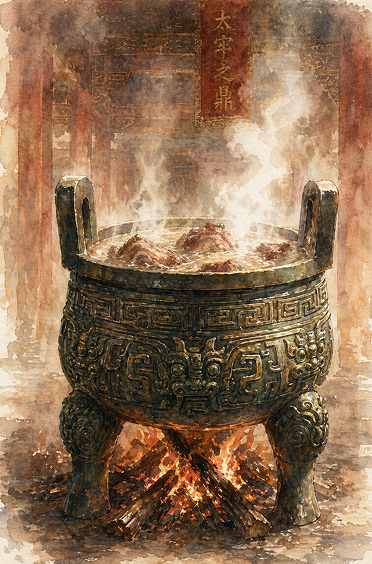
Ting / The Caldron
䷱Fire (Li) · Wind (Xun)
Fire Over Wood
The six lines construct the image of Ting, THE CALDRON; at the bottom are the legs, over them the belly, then come the ears (handles), and at the top the carrying rings. At the same time, the image suggests the idea of nourishment. The ting, cast of bronze, was the vessel that held the cooked viands in the temple of the ancestors and at banquets. The head of the family served the food from the ting into the bowls of the guests.1 THE WELL (48) likewise has the secondary meaning of giving nourishment, but rather more in relation to the people. The ting, as a utensil pertaining to a refined civilization, suggests the fostering and nourishing of able men, which redounded to the benefit of the state.2 This hexagram and THE WELL are the only two in the Book of Changes that represent concrete, man-made objects. Yet here too the thought has its abstract connotation. Sun, below, is wood and wind; Li, above, is flame. Thus together they stand for the flame kindled by wood and wind, which likewise suggests the idea of preparing food.
THE CALDRON. Supreme good fortune. Success.
While THE WELL relates to the social foundation of our life, and this foundation is likened to the water that serves to nourish growing wood, the present hexagram refers to the cultural superstructure of society. Here it is the wood that serves as nourishment for the flame, the spirit. All that is visible must grow beyond itself, extend into the realm of the invisible. Thereby it receives its true consecration and clarity and takes firm root in the cosmic order. Here we see civilization as it reaches its culmination in religion. The ting serves in offering sacrifice to God. The highest earthly values must be sacrificed to the divine. But the truly divine does not manifest itself apart from man. The supreme revelation of God appears in prophets and holy men. To venerate them is true veneration of God. The will of God, as revealed through them, should be accepted in humility; this brings inner enlightenment and true understanding of the world, and this leads to great good fortune and success.
The Cauldron is an image. Wood enters fire, and this produces a meal. The holy man prepares the meal to honor God, and the great meal is prepared to nourish the holy sages. Gentle and devoted, with ears and eyes clear, the yielding advances and moves upward, attains the middle and responds to the hard—hence supreme success.
The Cauldron is an image. Wood enters fire to produce a meal. The holy man prepares meals to honor God and nourish the holy sages. Gentleness and devotion with clear ears and eyes allow the yielding to advance upward, attaining the middle and responding to the hard.
Fire over wood: The image of THE CALDRON. Thus the superior man consolidates his fate By making his position correct.
The fate of fire depends on wood; as long as there is wood below, the fire bums above. It is the same in human life; there is in man likewise a fate that lends power to his life. And if he succeeds in assigning the right place to life and to fate, thus bringing the two into harmony, he puts his fate on a firm footing. These words contain hints about the fostering of life as handed on by oral tradition in the secret teachings of Chinese yoga.
A ting with legs upturned. Furthers removal of stagnating stuff. One takes a concubine for the sake of her son. No blame.
If a ting is turned upside down before being used, no harm is done—on the contrary, this clears it of refuse. A concubine’s position is lowly, but because she has a son she comes to be honored. These two metaphors express the idea that in a highly developed civilization, such as that indicated by this hexagram, every person of good will can in some way or other succeed. No matter how lowly he may be, provided he is ready to purify himself, he is accepted. He attains a station in which he can prove himself fruitful in accomplishment, and as a result he gains recognition.
A cauldron with upturned legs: there is nothing that would be a mistake. It furthers to get rid of what is spoiled: this means following the esteemed.
Upturned cauldron is no mistake. Removing the spoiled means following the esteemed.
There is food in the ting. My comrades are envious, But they cannot harm me. Good fortune.
In a period of advanced culture, it is of the greatest importance that one should achieve something significant. If a man concentrates on such real undertakings, he may indeed experience envy and disfavor, but that is not dangerous. The more he limits himself to his actual achievements, the less harm can the envious inflict on him.
There is food in the cauldron: be careful where you go. My enemies are envious: in the end there is no blame.
Food in cauldron—be careful where you go. Enemies envious but no blame in the end.
The handle of the ting is altered. One is impeded in his way of life. The fat of the pheasant is not eaten. Once rain falls, remorse is spent. Good fortune comes in the end.
The handle is the means for lifting up the ting. If the handle is altered, the ting cannot be lifted up and used, and, sad to say, the delicious food in it, such as pheasant fat, cannot be eaten by anyone. This describes a man who, in a highly evolved civilization, finds himself in a place where no one notices or recognizes him. This is a severe block to his effectiveness. All of his good qualities and gifts of mind thus needlessly go to waste. But if he will only see to it that he is possessed of something truly spiritual, the time is bound to come, sooner or later, when the difficulties will be resolved and all will go well. The fall of rain symbolizes here, as in other instances, release of tension.
The handle of the cauldron is altered: he loses his meaning.
Altered handle means losing meaning.
The legs of the ting are broken. The prince’s meal is spilled And his person is soiled. Misfortune.
A man has a difficult and responsible task to which he is not adequate. Moreover, he does not devote himself to it with all his strength but goes about with inferior people; therefore the execution of the work fails. In this way he also incurs personal opprobrium. Confucius says about this line: “Weak character coupled with honored place, meager knowledge with large plans, limited powers with heavy responsibility, will seldom escape disaster.”
The prince's meal is spilled: how can he be trusted?
Spilled meal means how can he be trusted?
The ting has yellow handles, golden carrying rings. Perseverance furthers.
Here we have, in a ruling position, a man who is approachable and modest in nature. As a result of this attitude he succeeds in finding strong and able helpers who complement and aid him in his work. Having achieved this attitude, which requires constant self-abnegation, it is important for him to hold to it and not to let himself be led astray.
The cauldron has yellow handles: the middle is grasped as the substantial.
Yellow handles mean grasping the middle as substantial.
The ting has rings of jade. Great good fortune. Nothing that would not act to further.
In the preceding line the carrying rings are described as golden, to denote their strength; here they are said to be of jade. Jade is notable for its combination of hardness with soft luster. This counsel, in relation to the man who is open to it, works greatly to his advantage. Here the counsel is described in relation to the sage who imparts it. In imparting it, he will be mild and pure, like precious jade. Thus the work finds favor in the eyes of the Deity, who dispenses great good fortune, and becomes pleasing to men, wherefore all goes well.
The jade ring at the top: the hard and the soft are properly regulated.
Jade ring at top means hard and soft are properly regulated.
What does Ting / The Caldron mean in the I Ching?
While THE WELL relates to the social foundation of our life, and this foundation is likened to the water that serves to nourish growing wood, the present hexagr...
How should I study Hexagram 50 on this page?
Start with the judgment and image, then read the line statements in sequence. If a ting is turned upside down before being used, no harm is done—on the contrary, this clears it of refuse. A concubine’s position is lowly, but because she has a son she comes t...
How can this hexagram be applied in a modern reading?
The Cauldron is an image. Wood enters fire to produce a meal. The holy man prepares meals to honor God and nourish the holy sages. Gentleness and devotion with clear ears and eyes allow the yielding to advance upward, at...
Original text from the I Ching; translation based on Richard Wilhelm's German version.
Move from each guide into related hexagrams, companion topics, and a steadier reading practice.
Hexagram Career
Hexagram 50 (The Caldron) in Career: I Ching Guidance for Work and Professional Life
What does Hexagram 50 (The Caldron) mean for your career? While THE WELL relates to the social foundation of our life, and this foundation is likened to the water that serves to nourish growing wood, the present hexagr... Learn how the I Ching guides professional decisions, leadership, timing, and workplace dynamics.
Hexagram Finance
Hexagram 50 (The Caldron) in Finance: I Ching Guidance for Wealth and Money Matters
What does Hexagram 50 (The Caldron) mean for finances? While THE WELL relates to the social foundation of our life, and this foundation is likened to the water that serves to nourish growing wood, the present hexagr... Discover how the I Ching guides resource management, timing of financial decisions, and the mindset behind lasting wealth.
Hexagram Study
Hexagram 50 (The Caldron) in Study: I Ching Guidance for Learning and Growth
What does Hexagram 50 (The Caldron) teach about study and learning? While THE WELL relates to the social foundation of our life, and this foundation is likened to the water that serves to nourish growing wood, the present hexagr... See how the I Ching guides intellectual growth, skill development, and the discipline of deepening knowledge.
Hexagram Study
I Ching Hexagram Meanings: How to Read the 64 Patterns
Understand how I Ching hexagram meanings work, from the overall pattern to the image, line statements, and modern interpretation.
How To
How to Read Changing Lines in the I Ching
Learn how changing lines work in the I Ching and how to interpret them without overcomplicating the reading.
How To
How to Read the I Ching: A Beginner Path from Hexagram to Action
Learn how to read the I Ching step by step, from identifying the hexagram to interpreting line meanings and translating the result into action.
Study Deeper in the App
Download our iOS App for a complete I Ching experience
Sync Everywhere: Access your readings and notes anytime
Deep Insights: Explore life's questions with advanced AI
Premium Design: Immersive visuals and traditional aesthetics
Offline Mode: Access hexagram texts without internet
4.8/5.0 App Store Rating · 10,000+ Users