
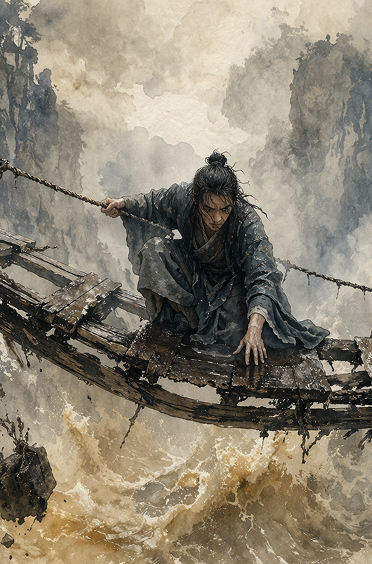
Ta Kuo / Preponderance of the Great
䷛Lake (Dui) · Wind (Xun)
Lake Rising Above the Trees
This hexagram consists of four strong lines inside and two weak lines outside. When the strong are outside and the weak inside, all is well and there is nothing out of balance, nothing extraordinary in the situation. Here, however, the opposite is the case. The hexagram represents a beam that is thick and heavy in the middle but too weak at the ends. This is a condition that cannot last; it must be changed, must pass, or misfortune will result.
PREPONDERANCE OF THE GREAT. The ridgepole sags to the breaking point. It furthers one to have somewhere to go. Success.
The weight of the great is excessive. The load is too heavy for the strength of the supports. The ridgepole, on which the whole roof rests, sags to the breaking point, because its supporting ends are too weak for the load they bear. It is an exceptional time and situation; therefore extraordinary measures are demanded. It is necessary to find a way of transition as quickly as possible, and to take action. This promises success. For although the strong element is in excess, it is in the middle, that is, at the center of gravity, so that a revolution is not to be feared. Nothing is to be achieved by forcible measures. The problem must be solved by gentle penetration to the meaning of the situation (as is suggested by the attribute of the inner trigram, Sun); then the change-over to other conditions will be successful. It demands real superiority; therefore the time when the great preponderates is a momentous time.
Preponderance of the Great. The great is in a preponderant place. The ridgepole sags to the breaking point because the firm is represented by two weak lines at top and bottom. The yielding finds place and thereby is joyous; the firm is in the center and thereby is able to interact. Thus 'it furthers one to have somewhere to go' and 'success.'
Preponderance of the Great shows greatness exceeding normal bounds. The ridgepole sags because firmness is surrounded by weakness above and below. The yielding finds proper place and is joyous; the firm is central and can interact. Thus progress and success are possible.
The lake rises above the trees: The image of PREPONDERANCE OF THE GREAT. Thus the superior man, when he stands alone, Is unconcerned, And if he has to renounce the world, He is undaunted.
Extraordinary times when the great preponderates are like floodtimes when the lake rises over the treetops. But such conditions are temporary. The two trigrams indicate the attitude proper to such exceptional times: the symbol of the trigram Sun is the tree, which stands firm even though it stands alone, and the attribute of Tui is joyousness, which remains undaunted even if it must renounce the world.
To spread white rushes underneath. No blame.
When a man wishes to undertake an enterprise in extraordinary times, he must be extraordinarily cautious, just as when setting a heavy thing down on the floor, one takes care to put rushes under it, so that nothing will break. This caution, though it may seem exaggerated, is not a mistake. Exceptional enterprises cannot succeed unless utmost caution is observed in their beginnings and in the laying of their foundations.
To spread white rushes underneath shows the yielding who finds place below.
Spreading white rushes underneath shows the yielding properly placed below.
A dry poplar sprouts at the root. An older man takes a young wife. Everything furthers.
Wood is near water; hence the image of an old poplar sprouting at the root. This means an extraordinary reanimation of the processes of growth. In the same way, an extraordinary situation arises when an older man marries a young girl who suits him. Despite the unusualness of the situation, all goes well. From the point of view of politics, the meaning is that in exceptional times one does well to join with the lowly, for this affords a possibility of renewal.
A withered poplar puts forth flowers. How could this last long? An older woman taking a husband. It is a disgrace to the undertaking.
A withered poplar flowering cannot last long. An older woman taking a husband brings disgrace.
The ridgepole sags to the breaking point. Misfortune.
This indicates a type of man who in times of preponderance of the great insists on pushing ahead. He accepts no advice from others, and therefore they in turn are not willing to lend him support. Because of this the burden grows, until the structure of things bends or breaks. Plunging willfully ahead in times of danger only hastens the catastrophe.
The ridgepole sags to the breaking point. One cannot support it from the ends.
The sagging ridgepole cannot be supported from the ends alone.
The ridgepole is braced. Good fortune. If there are ulterior motives, it is humiliating.
Through friendly relations with people of lower rank, a responsible man succeeds in becoming master of the situation. But if, instead of working for the rescue of the whole, he were to misuse his connections to obtain personal power and success, it would lead to humiliation.
The ridgepole is braced. It does not sag downward. If there are ulterior motives, it is humiliating, because the yielding is in an unsuitable place.
Bracing the ridgepole prevents downward sag. Ulterior motives bring humiliation when the yielding is misplaced.
A withered poplar puts forth flowers. An older woman takes a husband. No blame. No praise.
A withered poplar that flowers exhausts its energies thereby and only hastens its end. An older woman may marry once more, but no renewal takes place. Everything remains barren. Thus, though all the amenities are observed, the net result is only the anomaly of the situation.Applied to politics, the metaphor means that if in times of insecurity we give up alliance with those below us and keep up only the relationships we have with people of higher rank, an unstable situation is created.
A withered poplar puts forth sprouts. The older man obtains a wife. The strong achieves support below.
A withered poplar sprouting shows the older man finding support through the strong below.
One must go through the water. It goes over one’s head. Misfortune. No blame.
Here is a situation in which the unusual has reached a climax. One is courageous and wishes to accomplish one’s task, no matter what happens. This leads into danger. The water rises over one’s head. This is the misfortune. But one incurs no blame in giving up one’s life that the good and the right may prevail. There are things that are more important than life.
One must go through the water. It goes over one's head. Misfortune. No blame. One could not have done it differently.
Water going over one's head brings misfortune but no blame when circumstances permit no alternative.
What does Ta Kuo / Preponderance of the Great mean in the I Ching?
The weight of the great is excessive. The load is too heavy for the strength of the supports. The ridgepole, on which the whole roof rests, sags to the breaking...
How should I study Hexagram 28 on this page?
Start with the judgment and image, then read the line statements in sequence. When a man wishes to undertake an enterprise in extraordinary times, he must be extraordinarily cautious, just as when setting a heavy thing down on the floor, one takes care to pu...
How can this hexagram be applied in a modern reading?
Preponderance of the Great shows greatness exceeding normal bounds. The ridgepole sags because firmness is surrounded by weakness above and below. The yielding finds proper place and is joyous; the firm is central and ca...
Original text from the I Ching; translation based on Richard Wilhelm's German version.
Move from each guide into related hexagrams, companion topics, and a steadier reading practice.
Hexagram Career
Hexagram 28 (Preponderance of the Great) in Career: I Ching Guidance for Work and Professional Life
What does Hexagram 28 (Preponderance of the Great) mean for your career? The weight of the great is excessive. The load is too heavy for the strength of the supports. The ridgepole, on which the whole roof rests, sags to the breaking... Learn how the I Ching guides professional decisions, leadership, timing, and workplace dynamics.
Hexagram Health
Hexagram 28 (Preponderance of the Great) in Health: I Ching Guidance for Wellbeing and Vitality
What does Hexagram 28 (Preponderance of the Great) suggest about health and wellbeing? The weight of the great is excessive. The load is too heavy for the strength of the supports. The ridgepole, on which the whole roof rests, sags to the breaking... Explore how the I Ching frames the balance of energy, rest, and renewal.
Hexagram Study
I Ching Hexagram Meanings: How to Read the 64 Patterns
Understand how I Ching hexagram meanings work, from the overall pattern to the image, line statements, and modern interpretation.
How To
How to Read Changing Lines in the I Ching
Learn how changing lines work in the I Ching and how to interpret them without overcomplicating the reading.
How To
How to Read the I Ching: A Beginner Path from Hexagram to Action
Learn how to read the I Ching step by step, from identifying the hexagram to interpreting line meanings and translating the result into action.
Study Deeper in the App
Download our iOS App for a complete I Ching experience
Sync Everywhere: Access your readings and notes anytime
Deep Insights: Explore life's questions with advanced AI
Premium Design: Immersive visuals and traditional aesthetics
Offline Mode: Access hexagram texts without internet
4.8/5.0 App Store Rating · 10,000+ Users